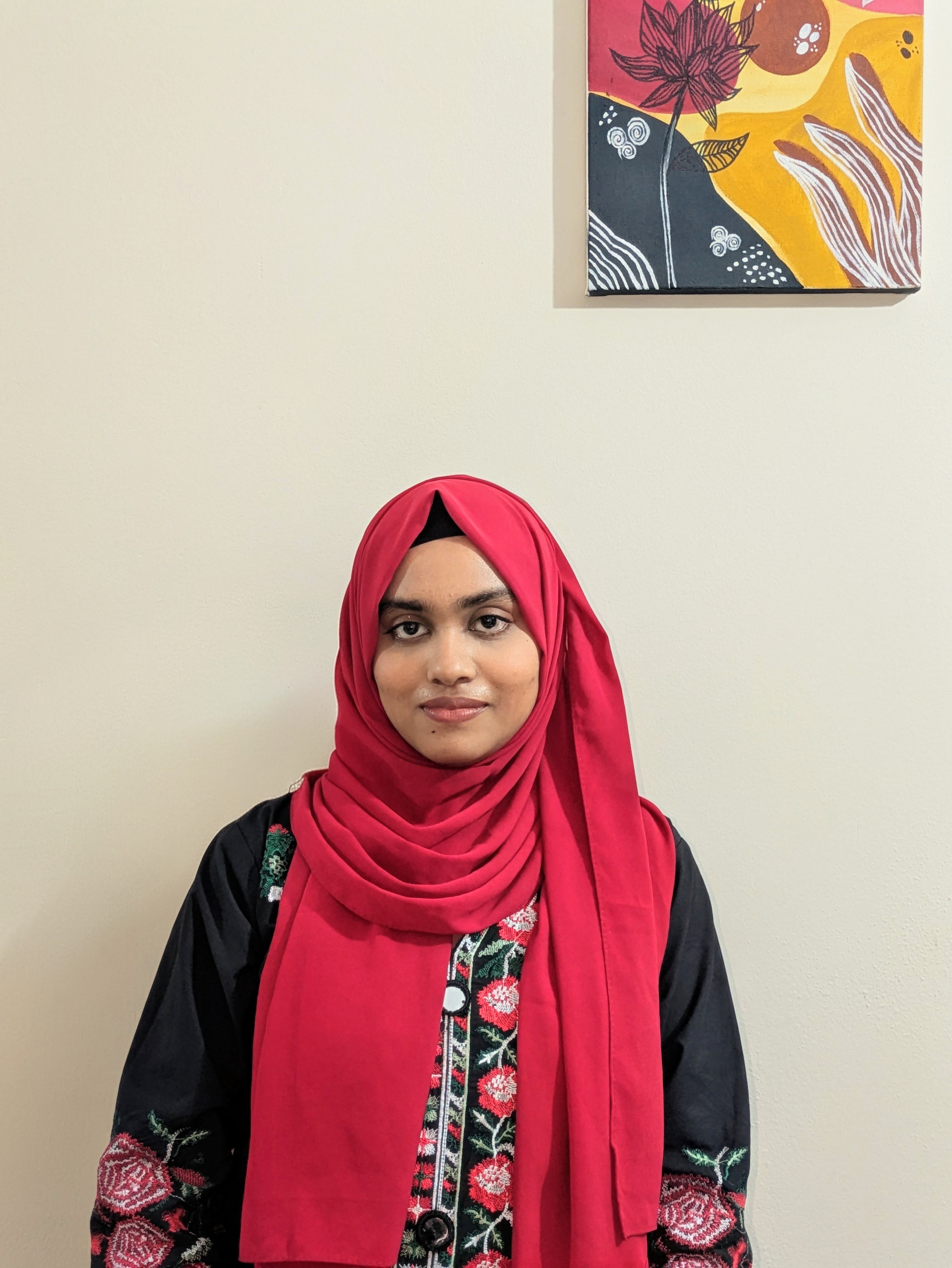
Bridging Software Engineering and Computational Biology
Hi, I'm Tasfia Noor, a CSE graduate from Rajshahi University of Engineering & Technology (RUET),
transitioned into computational biology research, driven by the conviction that rigorous
software engineering can accelerate biological discovery. Since November 2023 I have been
working as a Research Assistant in the Bioinformatics Lab (Dry) at the University of
Rajshahi's Department of Statistics, where I design and implement bioinformatics
pipelines, R packages, and web-based platforms that integrate multi-omics data, spanning
genomics, transcriptomics, proteomics, and metagenomics to identify therapeutic
candidates.
My current research centers on disease co-morbidity and co-infection key-gene discovery:
uncovering the shared molecular mechanisms that link conditions such as dengue/SARS-CoV-2
co-infection, type-2 diabetes and myocardial infarction, and cancer comorbidities with
metabolic disease. This work feeds directly into biomarker identification, PPI network
analysis, molecular docking, and drug repurposing pipelines. I am actively seeking a
PhD position where I can deepen this integrative approach and contribute to a
computationally-driven understanding of complex diseases.
7+
Peer-reviewed
publications
2+
Years research
experience
4
Journals under
review
Quick Info
Rajshahi, Bangladesh
B.Sc. CSE, RUET (2024)
Bioinformatics Lab (Dry), Rajshahi University
Multi-omics · Drug Repurposing · Biomarker Discovery
Focus Areas
Research Interests
Multi-omics Integrative Analysis
Microarray, RNA-seq, and single-cell RNA-seq (scRNA-seq) data integration to uncover disease mechanisms across molecular layers.
Biomarker & Key-Gene Discovery
Identification of diagnostic and prognostic biomarkers through differential expression analysis, and protein–protein interaction (PPI) network analysis.
Drug Repurposing & Vaccine Discovery
Computational pipelines leveraging existing drug databases and multi-omics signatures to identify repurposable therapeutics.
Molecular Docking & ADMET
Structure-based virtual screening using AutoDock Vina, followed by pharmacokinetic profiling with SwissADME, pkCSM, and ADMETlab.
Machine Learning for Biological Data
Applying supervised and ensemble ML methods (Random Forest, feature selection) to filter molecular signatures and classify disease states from high-dimensional omics data.
Work History
Experience
Research Assistant
University of Rajshahi
Bioinformatics Lab (Dry), Department of Statistics
Nov 2023 – Present
Rajshahi, Bangladesh
Designs and implements bioinformatics algorithms, R packages, and web-based platforms for drug and vaccine discovery.
Conducts integrative multi-omics analysis across genomics, transcriptomics, proteomics, and metagenomics data.
Identifies disease co-morbidity/co-infection key-genes, biomarkers, and drug repurposing candidates.
Applies PPI network analysis, molecular docking (AutoDock Vina), and ADMET evaluation pipelines.
Co-authored 7+ peer-reviewed publications in journals including Scientific Reports, PLOS ONE, and Briefings in Bioinformatics.
R Python Bioinformatics Multi-omics Drug Repurposing
Software Developer
RemoteIntegrity, LLC
Mar 2025 – Sep 2025
Remote
Built secure Node.js backend systems to automate supplier Excel processing and streamline data ingestion pipelines.
Developed dynamic energy-pricing matrices across multiple suppliers, utilities, and U.S. states.
Implemented JWT-based authentication and authorization for secure API endpoints.
Node.js JWT REST API Excel Automation
Scholarly Work
Publications
Peer-Reviewed Journals · 9 articles
Published
2026
Large-scale transcriptomic data mining using explainable XGBoost and SHAP reveals shared biomarkers and molecular mechanisms between type-2 diabetes and triple-negative breast cancer for drug repurposing.
Ahmed MF, Sharma O, Noor T, Latif MA, Ahmed MF, Bashak M, Ahmed DM, Hossain MS, Mollah MNH
Genetic underpinnings of type-2 diabetes (T2D) with colorectal cancer (CRC): in-silico discovery of common molecular signatures, pathogenetic processes and therapeutic candidates.
Ahmmed R, Antu US, Noor T, Faysal MF, Sarker A, Mahmud S, Ajadee A, Mollah MNH
Journal of Genetic Engineering and Biotechnology DOI
Published
2026
In-silico identification of bacterial key-genes directly or indirectly associated with the development and progression of colorectal cancer for exploring anti-bacterial agents.
Pal NK, Kibria MK, Noor T, Ahmed MF, Islam MS, Ahmed MF, Latif MA, Ali M, Noman MA, Kundu D, Sharma O, Mollah MNH
In-silico discovery of druggable molecular signatures that drive dengue fever to severe dengue fever highlighting common pathogenesis through single-cell RNA-Seq analysis.
Noman MA, Latif MA, Ahmmed MF, Islam MS, Pappu MAA, Hossain MS, Hossen MB, Noor T, Kabir MH, Mollah MNH
Screening of common genomic biomarkers to explore common drugs for the treatment of pancreatic and kidney cancers with type-2 diabetes through bioinformatics analysis.
Ajadee A, Mahmud S, Sarkar A, Noor T, Ahmmed R, Mollah MNH
Exploring common genomic biomarkers to disclose common drugs for the treatment of colorectal cancer and hepatocellular carcinoma with type-2 diabetes through transcriptomics analysis.
Mahmud S, Ajadee A, Sarker A, Ahmmed R, Noor T, Pappu MAA, et al.
Computational discovery of common host key-genes (chKGs) and their mechanisms associated with Dengue–SARS-CoV-2 co-infection for exploring common therapies through integrated RNA-seq profile analysis.
Noor T, Faysal MF, Ahmed R, Ahmed MF, Sharma O, Kabir MH, Kabir MR, Kabir MMJ, Mollah MNH
PLOS ONE
Under Review
2026
Computational identification of druggable shared host-key-genes and their mechanisms linking idiopathic pulmonary fibrosis to tuberculosis, and dual-acting drug repurposing.
Faysal MF, Noor T, Shyla S, Sharma O, Ahmed MF, Ahmed R, Kabir MMJ, Mollah MNH
PLOS ONE
Under Review
2026
In-silico discovery of shared host key-genes (shKGs) and mechanisms by which Type-2 Diabetes increases the risk of tuberculosis, and repurposing dual-acting candidate drugs.
Faysal MF, Noor T, Shyla S, Sharma O, Ahmed MF, Ahmed R, Noor A, Kabir MMJ, Mollah MNH
Infection Genetics and Evolution
Under Review
2025
Identification of bacterial key-genes associated with type-2 diabetes for exploring anti-bacterial agents through 16S rRNA-Seq profile analysis.
Discovery of SARS-CoV-2 and Dengue-Virus co-infections causing shared host key-genes using bioinformatics and machine learning approaches for diagnosis and therapies.
Noor T, Faysal MF, Sadad N, Mondal MNI
8th International Conference on the Role of Statistics and Data Science in 4IR (ICRSDS4IR), Rajshahi, Bangladesh
Conference
2024
In-silico identification of shared hub-genes between idiopathic pulmonary fibrosis and tuberculosis diseases & drug repurposing.
Faysal MF, Afroge S, Noor T
2024 IEEE International Conference on Biomedical Engineering, Computer and Information Technology for Health (BECITHCON), pp. 67–72, IEEE
Link
Molecular Docking (AutoDock Vina, PyRx) ADMET Analysis (SwissADME, pkCSM, ADMETlab) RDKit Open Babel PyMOL Discovery Studio Visualizer
Machine Learning & Data Science
Scikit-learn Random Forest NumPy Pandas Matplotlib OpenCV
Academic Background
Education
B.Sc. in Computer Science & Engineering
Rajshahi University of Engineering & Technology (RUET)
Rajshahi, Bangladesh
CGPA3.68/4.00
Avg CGPA of 3rd & 4th Year3.87/4.00
Feb 2019 – May 2024
Higher Secondary Certificate (HSC)
Rajshahi College
Rajshahi, Bangladesh
CGPA5.00/5.00
Jul 2016 – Apr 2018
Honors & Activities
Activities
Project Showcasing (Software)
CSE Fest
RUET · Jun 2022
Participant
bdapps National Hackathon 2022
Rajshahi University · Aug 2022
Get in Touch
Contact
I am actively seeking PhD opportunities in Computational Biology and Bioinformatics.
If you are a PI or admissions coordinator interested in my work, please reach out — I would be glad to share my full CV and research statement.